

🏷️ For resellers
White label social media management, explained honestly
Most pages about white label social media management are vague on purpose. Here’s the straight version: it’s an operating model. You sell the service, own the client relationship, and deliver under your name — Nimply is the production floor behind you. It is not a rebrandable interface, and we won’t pretend otherwise.
The operating model
Front of house is yours. The production floor is ours.
Front of house · your brand
You ↔ your clients
- · Your pitch, your packages, your prices
- · Your proposals, reports, and check-in calls
- · Your name on every deliverable
- · Client sign-off — over email, or inside their workspace via the client approval flow
briefs in ·
deliverables out
Production floor · Nimply
One workspace per client
- · Channels, calendar, and inbox scoped per client
- · An AI agent bench drafting per workspace
- · The approval pipeline every post must ride
- · Per-run AI credits, attributable per client
The line between the two halves is the point: clients buy an outcome from you; you buy production leverage from us.
Behind the curtain
The staff you resell but never have to hire
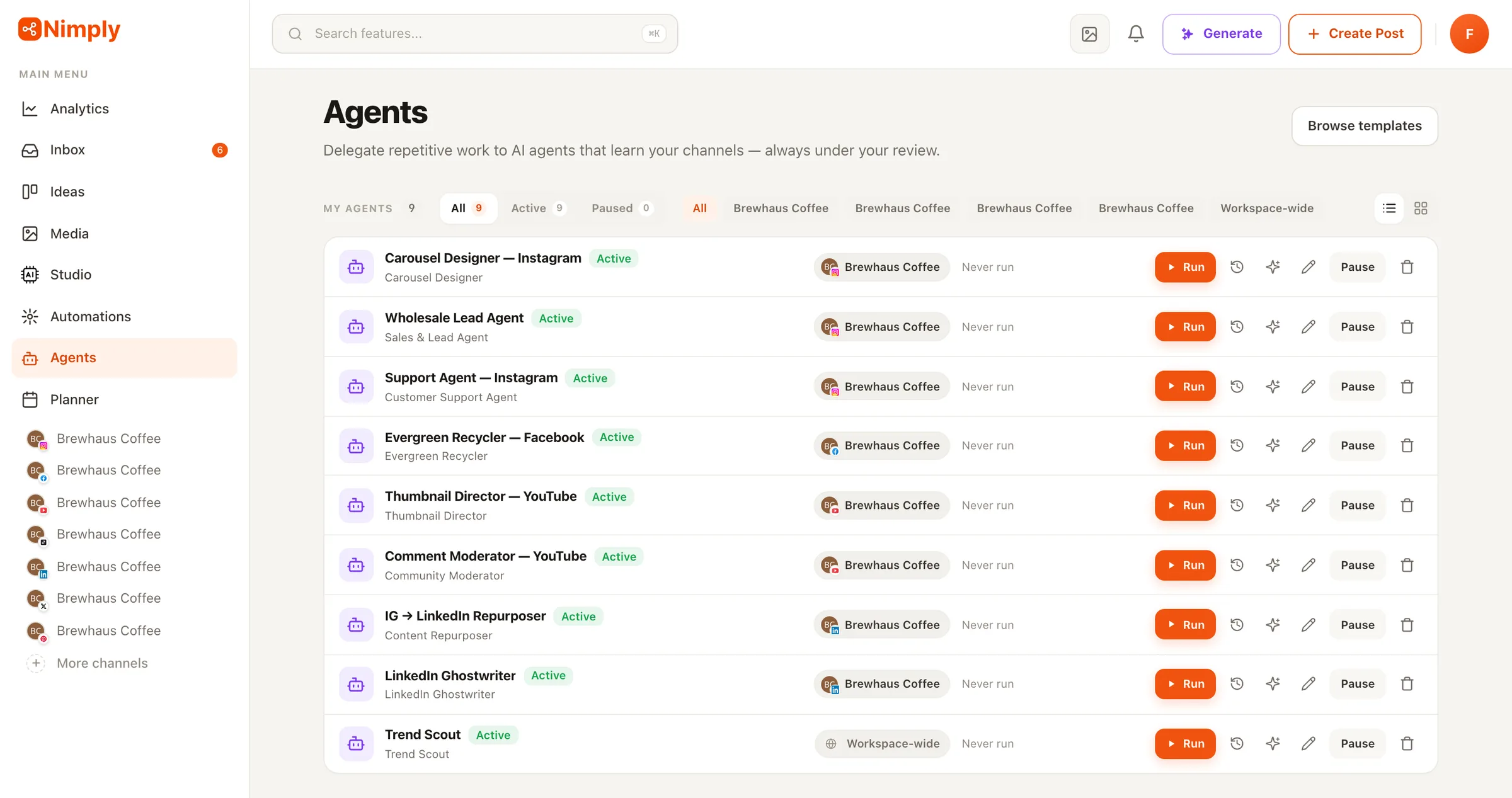
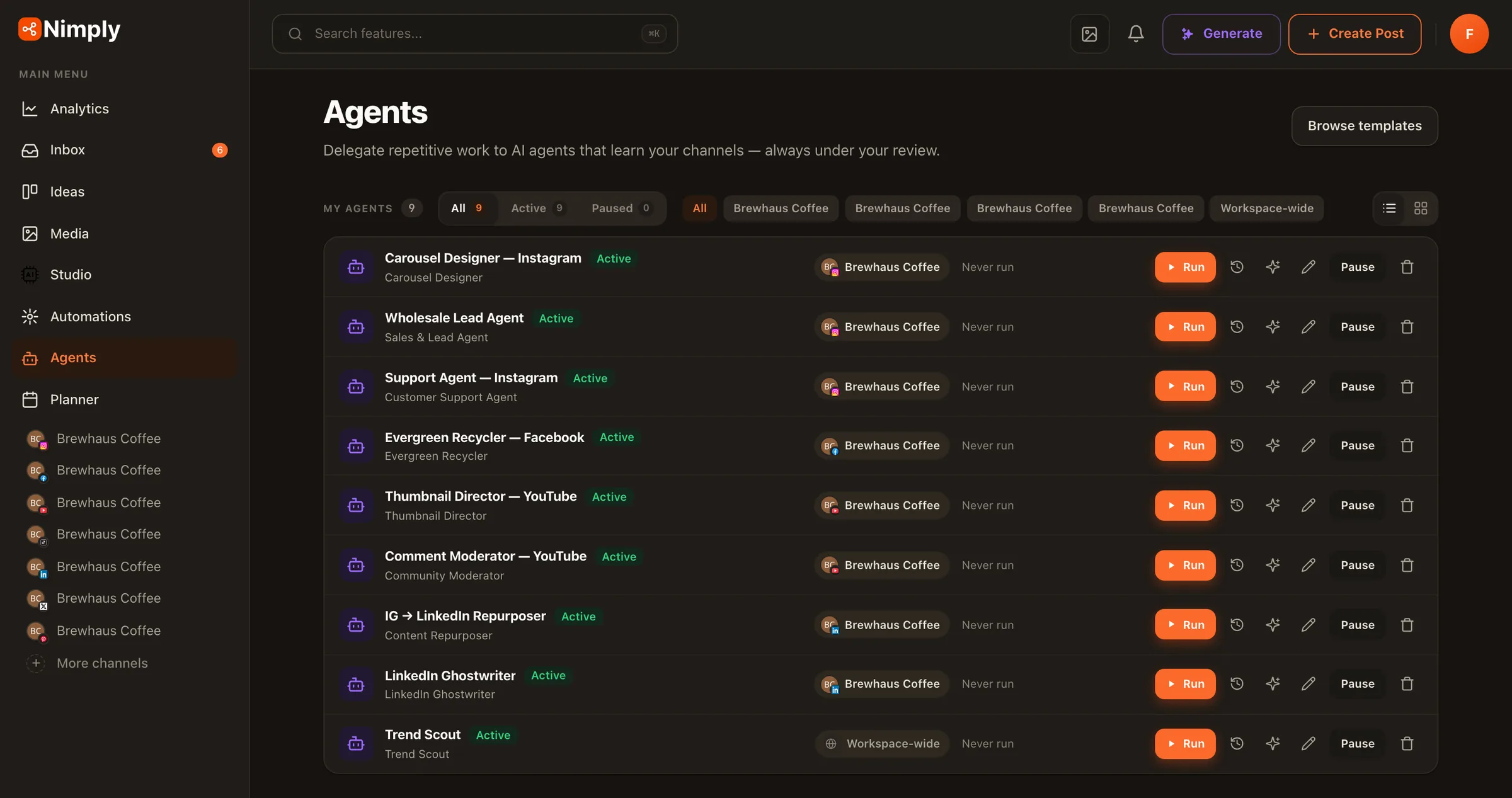
A reselling business is a production business. Each client workspace gets its own bench: the Evergreen Recycler keeps calendars full from content that already worked, the Content Repurposer turns one asset into platform-native drafts, and the Customer Support agent drafts inbox replies for whoever on your side hits send.
On margins, we’ll stay qualitative on purpose: agent drafting reduces the production hours inside each account, and the credit cost of every run is visible — so you price your packages from real numbers, not our marketing.
Why the rails matter more for you
Your name is on the invoice. The rails protect it.
When production scales past what you personally touch, the system has to enforce quality for you.
Nothing publishes unreviewed
Draft → pending approval → scheduled, for humans and agents alike. Whoever you trust with approval — you, a lead VA, or the client — is the gate.
Scoped access for subcontractors
OWNER, ADMIN, EDITOR, VIEWER roles per workspace mean a contractor sees exactly one client's world, never your whole roster.
Automations you can audit
Comment-to-DM flows, scheduled agent runs, and Slack or Telegram notifications run on a visible canvas with test simulation and execution history — no invisible robots on client accounts.
Adjacent playbooks
Same floor, different front of house
If you’re selling your own team’s strategy work under your agency brand, read the agencies playbook. If you’re a solo operator delivering social as one of several services, the virtual assistants page maps the same workspace model onto that job. And the team collaboration pillar covers the roles-and-approvals machinery both run on.
White label social media management — FAQ
Can I put my logo on Nimply, or use my own domain?
No — and we'd rather tell you that on the landing page than after you've signed up. Nimply does not currently ship custom branding, custom domains, a white-labeled UI, or client-facing branded portals. What it does ship is the operating model underneath a reselling business: isolated per-client workspaces, role-based access, and an approval pipeline your clients can use. Your brand lives on your proposals, reports, and relationship — not on our interface.
So what does 'white label' mean here, honestly?
It describes your business model, not our UI. You sell managed social media as your own service, at your own prices, under your own name — and run production on Nimply the way a design studio runs on Figma. Clients buy an outcome from you; the tooling behind it is your call to disclose or not.
Do my clients ever have to see Nimply?
Only if you want them in the approval loop. Many resellers keep clients entirely outside the tool and handle sign-off over email or calls. If you do invite a client, they get a limited role in their own workspace and see just that workspace — typically only the pending-approval queue.
How do I keep ten client accounts from bleeding into each other?
One workspace per client, with hard separation: channels, calendar, inbox, agents, automations, and AI credits are all scoped to the workspace. Your subcontractors or VAs can be editors on exactly the workspaces they work, and nowhere else.
Where does the margin in this model actually come from?
From hours, qualitatively: agent drafting compresses the production side of each account — reply drafts, repurposed posts, recycled evergreen content, carousels — while approval rails keep quality your responsibility. We won't hand you invented percentages; how much time it saves depends on your service scope, and every agent run shows its credit cost so you can price from real usage.
Can the AI ever publish something on a client account by itself?
No. Agents never publish directly — every output enters the draft → pending approval → scheduled pipeline. When your name is on the invoice and someone else's brand is on the account, that guardrail is non-negotiable.
Sell the service. We'll be the floor it runs on.
Per-client workspaces, an AI production bench, and approval rails that protect the name on the invoice — yours.