

Answers from your facts
You write the business context once — offering, hours, shipping, policies, tone. The agent answers from it and refuses to invent what it doesn't know.
🎧 Customer Support Agent
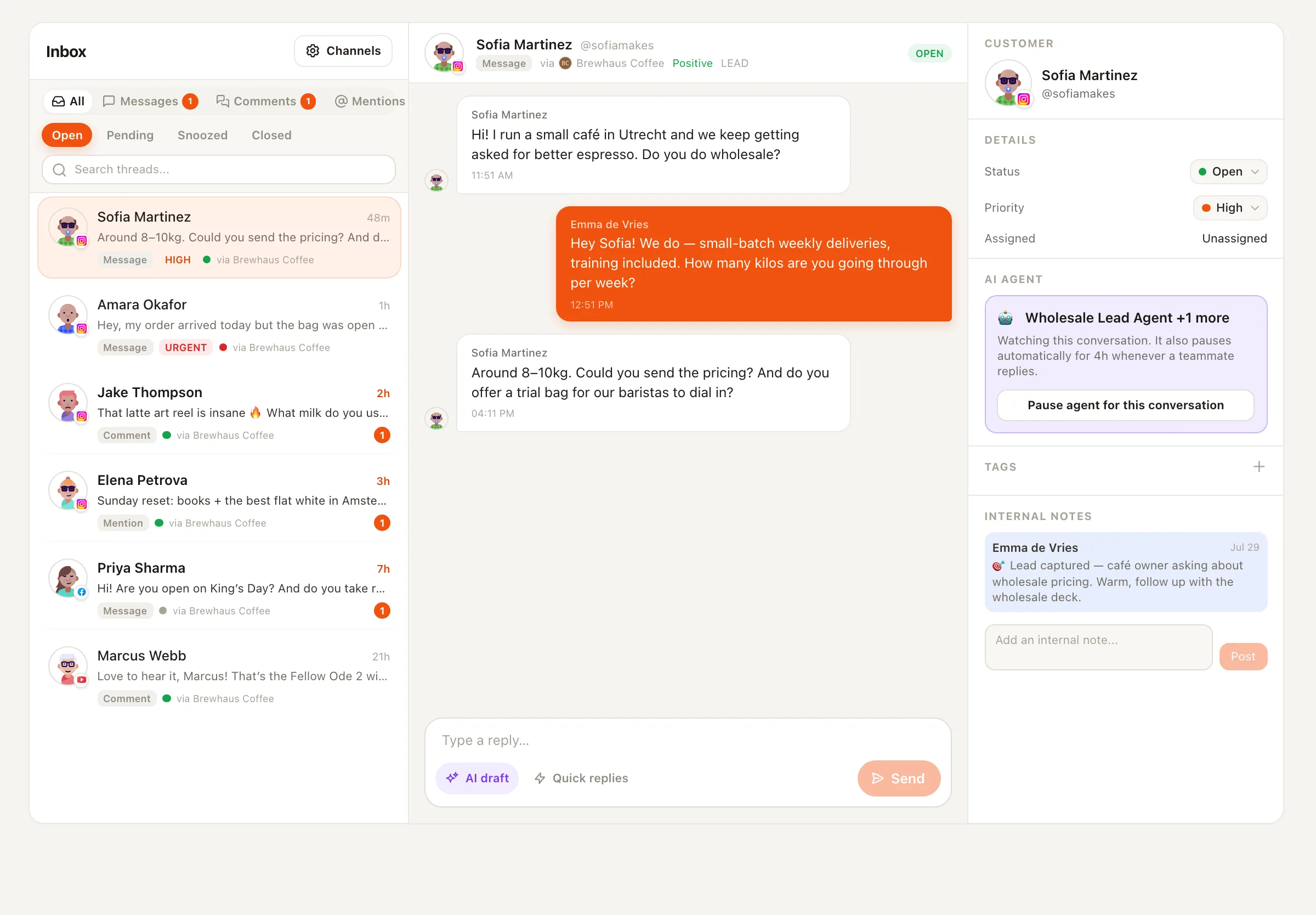
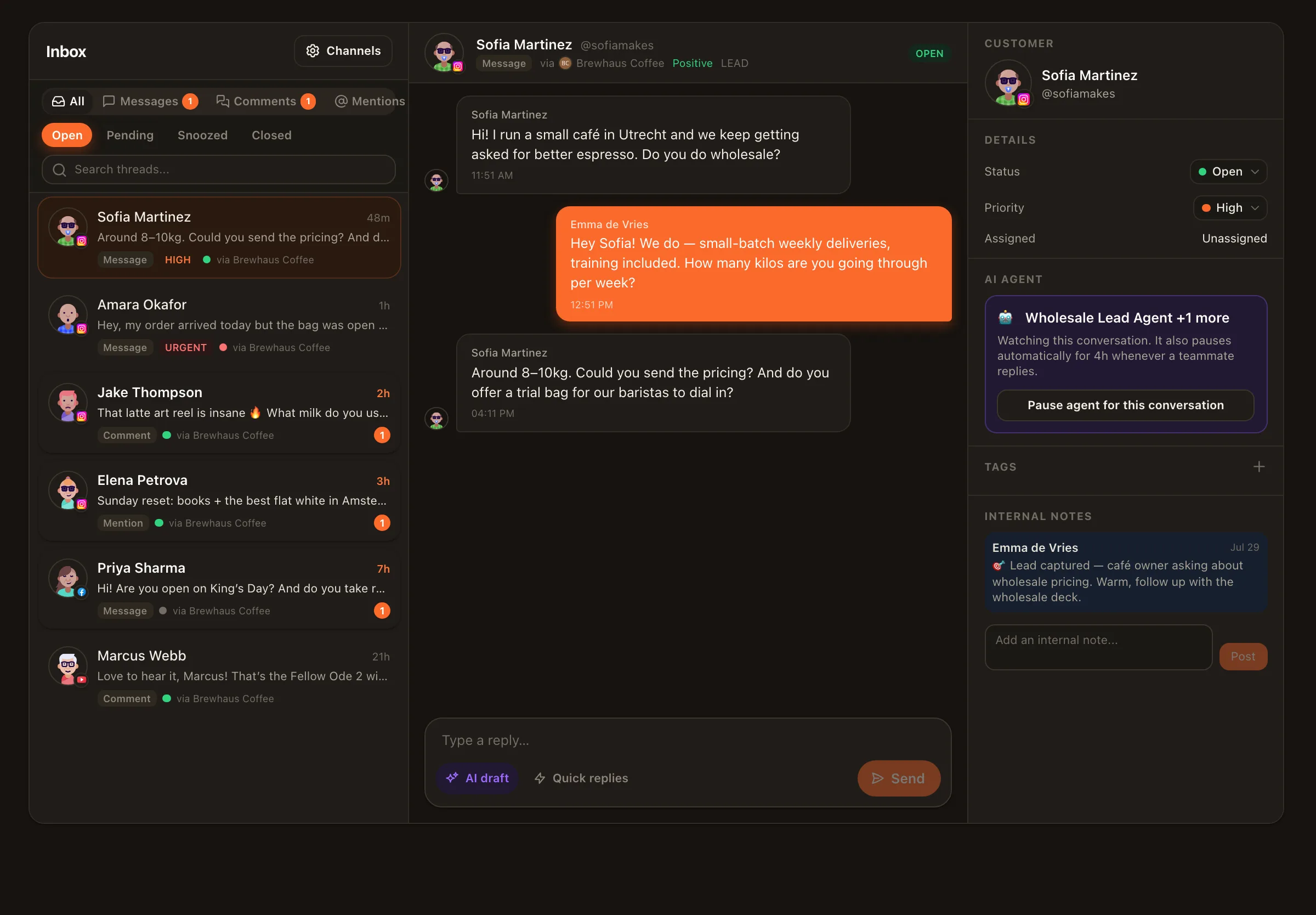
Customers ask the same questions in your DMs every day — hours, shipping, sizing, “where’s my order?”. This agent reads each conversation, answers from your real business context, and drafts the reply for your team to send. When you trust it, flip it to auto.
Draft-first by default · pauses when a human takes over · every run logged
What it does
You write the business context once — offering, hours, shipping, policies, tone. The agent answers from it and refuses to invent what it doesn't know.
Connect your order system, booking tool, or help docs as MCP servers and the agent checks real order status and availability mid-conversation.
It studies how your team actually replies — greetings, emoji, sign-offs — so drafts sound like you, not like a bot template.
Angry customer? Refund decision? It marks the thread urgent, leaves a note with what it found, and gets out of the way.
Comments only, DMs only, or both. Public comment replies stay appropriate for an audience; DMs can go into account detail.
Every time you correct a draft before sending, it saves the lesson — visible, editable, and applied to the next conversation.
Trust dial
Autonomy is a dial, not a switch. Most teams run the agent in draft mode for a couple of weeks, watch the quality, then switch busy channels to auto — with the guardrails still on.
The agent attaches its suggested reply to the conversation as an internal note. Your team reviews, edits, sends — and the agent learns from every edit.
The agent replies on its own, capped per conversation per hour, clearly attributed, and automatically silent for hours whenever a teammate joins in.
One click on any thread mutes the agent there — for the tricky customer, the influencer negotiation, the conversation you just want to own.
Prefer to answer yourself? Set the agent to only step in when you haven't replied on that channel recently.
A real run, step by step
1 · Customer writes
“Hey, my order arrived today but the bag was open and half the beans spilled 😞 Order #2481.”
2 · Agent reads the thread
Full history + your business context + how your team usually handles damage claims.
3 · Agent checks your systems
lookup_order(#2481) via your connected MCP server → shipped Monday, batch 240-C.
4 · Agent drafts
Apology in your voice, replacement offer per your policy, asks for a photo of the batch code.
5 · Your team sends
One tweak to the wording. The agent saves the correction and applies it next time.
When a support conversation turns into buying intent, the sales agent captures and qualifies the lead.
Keeps spam and scams out of your comments so the support agent only spends credits on real customers.
Classify every new conversation by sentiment and intent, alert Slack on complaints, and tag the rest.
During setup you give it your business context in plain language — what you sell, hours, shipping times, return policy, tone. For live facts it can't know (order status, stock, bookings), you can connect your systems as MCP servers and the agent looks the answer up during the conversation. Everything it uses is visible in its run log.
Your choice, per agent. In draft mode (the default) it attaches a suggested reply to the conversation as an internal note — your team reviews, edits, and sends. In auto mode it replies on its own, with an hourly rate limit per conversation, and automatically stands down for hours whenever a teammate replies. You can also pause it on any single conversation with one click.
Yes — you choose its scope during setup: comments only, DMs only, or both. Comment replies stay public-appropriate; DM replies can go deeper into account-specific detail.
It says so and escalates. The agent is instructed never to invent prices, policies, or promises — when a conversation needs a human (an angry customer, a refund decision, something outside its context), it marks the thread urgent and leaves a note explaining what it found.
Yes. When your team edits a drafted reply before sending, the agent compares your version against its own and saves the lesson — tone corrections, policy details, phrasing you prefer. Its memory is capped, scoped to the channel, and fully visible: you can read, edit, or delete anything it has learned.
It rides on Nimply's unified inbox. WhatsApp Business chats, Facebook Page DMs and comments, X (Twitter) DMs and mentions, YouTube and TikTok comments, Threads replies, and Telegram DMs and comments are available now; Instagram DMs and comments are in Meta's review. The agent itself is platform-agnostic — as each network unlocks, it just starts working there.
Hire the support agent free, give it your business context, and review its first drafts today.