

Nimply Logo

🔍 The worksheet

The social media audit checklist — run it, don’t read it

A social media audit isn’t a report you commission — it’s an afternoon of honest checks against what’s actually published, actually answered, and actually converting. This page is the worksheet: six numbered sections, concrete checks in each, and a map from findings to fixes at the end. Open your accounts in another tab and work top to bottom.

01

Profiles & bios

Your profiles are checked by more people than any single post ever will be. Audit them like a stranger seeing you for the first time.

  • Same name, handle, and avatar everywhere

    Search your brand on each platform. If the handle, display name, or logo differs, a searcher can't be sure it's you — consistency is the cheapest trust you can buy.

  • Bio says what you do and for whom

    Read each bio cold. Could a stranger say in one sentence what you offer and who it's for? Clever taglines fail this test more often than plain ones.

  • The one link works and goes somewhere current

    Click every profile link right now. Expired campaign pages and dead link-in-bio tools are embarrassingly common — and completely free to fix.

  • Abandoned profiles get a verdict

    For each platform you haven't touched in 90+ days: invest, maintain minimally, or retire it with a pinned pointer to where you're active. No zombie accounts.
02

Content mix

Pull your last 30 posts per platform and tag each one by job: educate, entertain, prove (results, testimonials), or sell.

  • No single job dominates

    If 25 of 30 posts sell, you've built a billboard nobody follows. If none do, you've built a magazine that never pays rent. You're looking for a deliberate mix, not an accidental one.

  • Formats match what each platform rewards

    Are you posting the formats the platform is built around — vertical video where video wins, carousels where saves matter, text where conversation lives — or the same asset everywhere?

  • Your best posts have a known 'why'

    Pick your top five posts by engagement. Can you articulate what made each work — topic, format, hook? If not, you can't repeat them, and repetition is the whole game.

  • The back catalog is being reused

    Evergreen winners posted once and never again are inventory sitting in a warehouse. Check whether anything older than six months still circulates.

03

Cadence & timing

Consistency compounds; bursts don't. Map when you actually published over the last 60 days — the calendar rarely matches the intention.

  • The gaps are smaller than the bursts

    Five posts in one week, then three silent weeks, reads as instability to both algorithms and audiences. A boring steady cadence beats an impressive erratic one.

  • Cadence per platform is a decision, not an accident

    Write down your intended frequency per platform. If you can't, that's the finding. If you can, compare it to what actually shipped.

  • Posting times reflect your audience, not your workday

    Are you publishing when your audience is active or when you happen to be at your desk? Your platform insights hold the answer — see our take on best times to post for how to test this properly.

04

Engagement & response times

Open your DMs, comments, and mentions from the past two weeks. This is the section teams most dread — and most need.

  • Nothing customer-shaped went unanswered

    Count messages and comments containing a genuine question or complaint that got no reply. Any number above zero is a lead or a customer you paid to acquire and then ignored.

  • You know your actual response time

    Measure the gap between a customer's message and your reply on your busiest channel. Guessing 'a few hours' and measuring 'two days' is the classic audit finding.

  • There's a target, and someone owns it

    A response-time expectation only becomes real when it has a number and a name attached. If neither exists, note it — this is what an SLA is for.

  • Spam and hate aren't squatting on your posts

    Scan recent comment sections. Scam links and abuse left standing tell every real commenter that nobody's home.

05

Conversion paths

Follow the road from each profile to money. Walk it yourself, on a phone, as a stranger would.

  • Every profile has a next step

    From each bio, is there an obvious action — book, buy, subscribe, download? A profile without one is a shop window with no door.

  • The path survives contact with a phone

    Tap through bio → link → landing page → action on mobile. Count the taps and the surprises. Every extra step sheds people who were ready to act.

  • Posts that sell, link to the thing they sell

    Check your recent promotional posts: does each one actually make the next step easy — in the caption, a pinned comment, or the bio it points to?

  • You can name where your last customers came from

    If nothing tells you which platform sends people who actually convert, every budget decision is folklore. Even rough link tracking beats none.

06

Tooling & workflow

Finally, audit the machine that produces all of the above. Most content problems are workflow problems wearing a disguise.

  • Publishing doesn't depend on one person's memory

    If posts go out only when a specific human remembers, your cadence has a single point of failure. A shared calendar is the fix, not more discipline.

  • There's a review step before publish

    Who saw the last post before the audience did? Typos and off-brand takes are cheap to catch in a draft and expensive to catch in the replies.

  • Reporting happens on a schedule

    When did you last look at your numbers with intent to change something? If the answer is 'when something went wrong', measurement is a smoke alarm, not a strategy.

  • Repetitive work is actually automated

    List what your team does weekly by hand — copying posts between platforms, pasting hashtags, answering the same DM. Each item is a candidate for automation or deletion.

Scoring tip: don’t grade yourself out of 23. Mark each check pass / fail / unknown — the “unknown” pile is usually the most important finding of the whole audit, because it shows where you’re flying without instruments. For timing questions in §3, our best-time-to-post guide covers how to test slots properly.

After the audit

Fixing what you found

An audit that ends in a document changes nothing. Here’s how each section’s typical findings map to the machinery in Nimply — so the next audit is a formality.

§01–02 · Inconsistent profiles, accidental content mix

Plan by category on one calendar

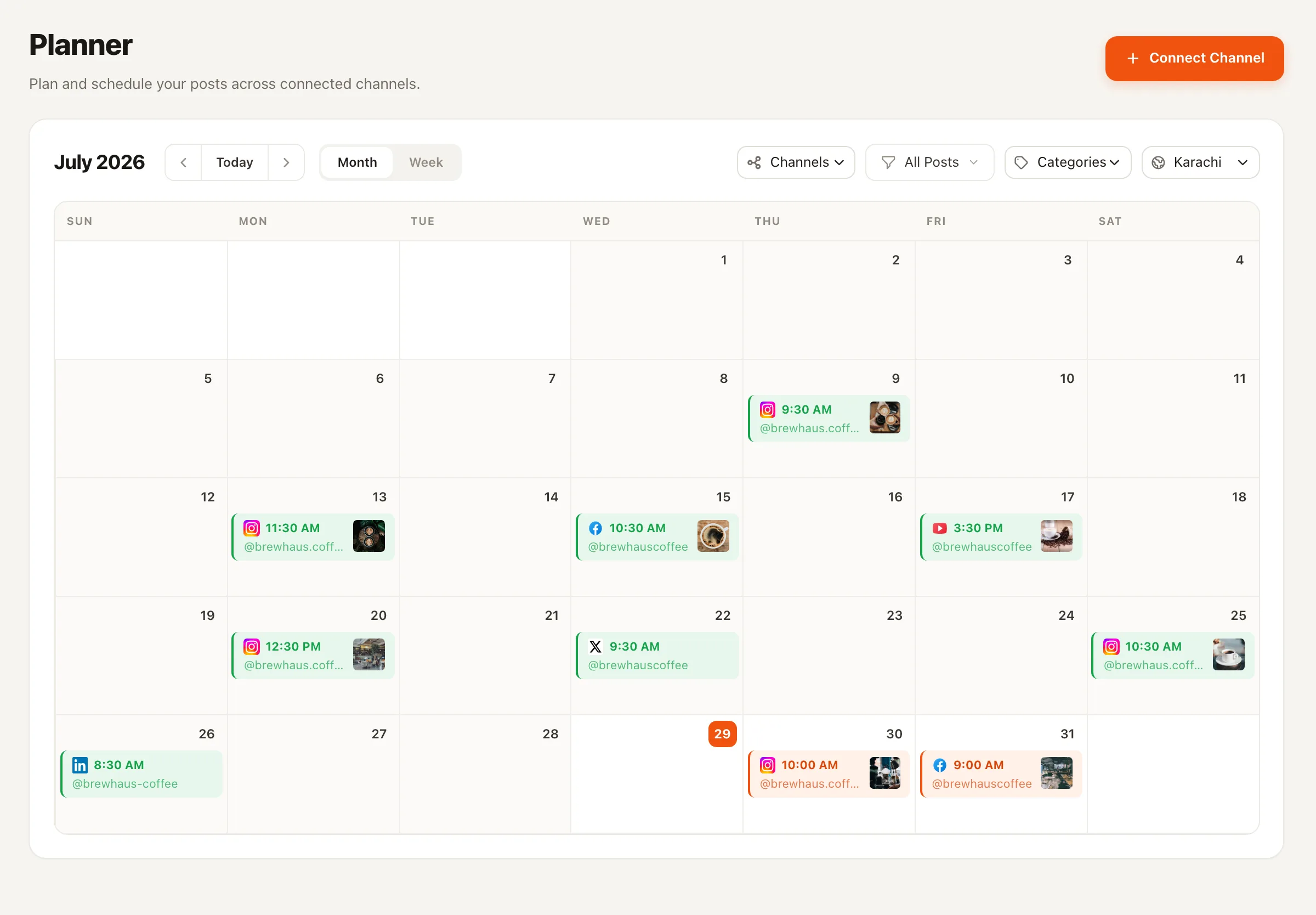
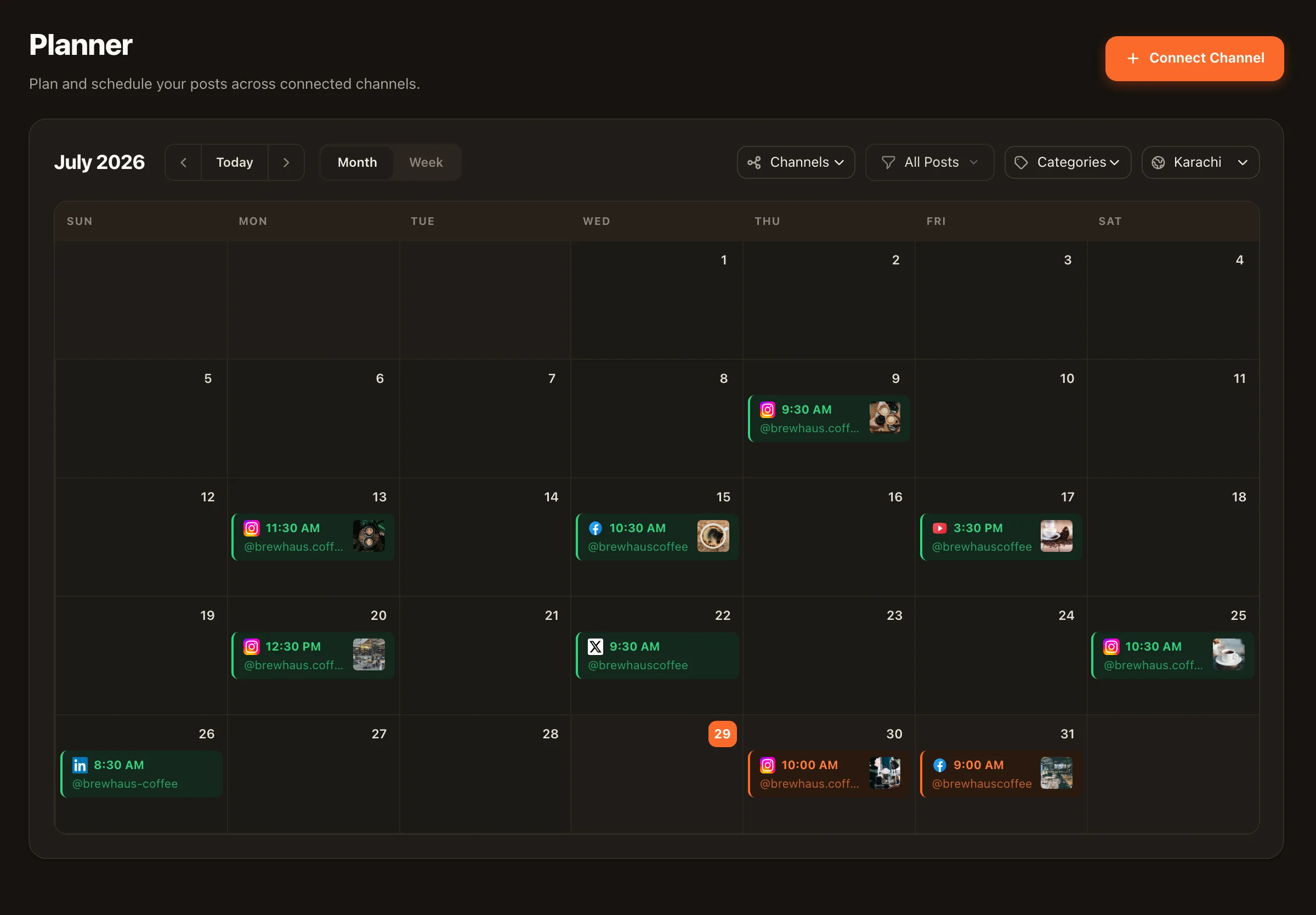
Color-coded categories on Nimply's content calendar make your mix visible before it ships — the imbalance you found in §2 becomes obvious at a glance.

Content calendar

§03 · Erratic cadence, desk-hours posting times

Best-time queues do the remembering

Define posting slots once; the queue fills them. Cadence stops depending on willpower, and timing stops defaulting to your work schedule.

Best time to post

§04 · Unanswered messages, unknown response times

One inbox with response-time targets

Nimply's unified inbox puts Facebook and Instagram comments, DMs, and mentions — plus YouTube comments — in one queue, and response-time SLAs turn 'answer faster' into a number with a breach warning.

Response-time SLAs

§05–06 · Unmeasured results, one-person workflow

Approvals, analytics, and a repeatable machine

Draft → approval → schedule keeps a review step in the loop, and analytics — YouTube-first today, more platforms as approvals land — make the quarterly re-check a five-minute job.

Analytics
The Nimply dashboard showing scheduled posts and workspace activity in one view
The post-audit state: one dashboard where cadence, approvals, and activity are visible instead of assumed.

Social media audit — FAQ

How long should a social media audit take?

An honest first pass through this checklist takes an afternoon for one brand — roughly 30 minutes per section. Resist the urge to fix things mid-audit; note the finding and keep moving. The fixing pass afterwards is faster when you can see all the findings at once and spot patterns, like three problems that all trace back to no posting schedule.

How often should I audit?

A full audit once or twice a year, plus a light quarterly pass over the sections that decay fastest: content mix, cadence, and response times. Profiles and conversion paths drift slower — annually is usually enough unless you've rebranded or changed your offer.

What data do I need before starting?

Access to each platform's native analytics, your last two to three months of published posts, and a look at your inbox or comments from the past few weeks. If part of your reporting already lives in a tool — Nimply's analytics are YouTube-first today, with more platforms as approvals land — pull that up too. You don't need a spreadsheet of every metric; the checks below tell you exactly what to look at.

Should I audit every platform I'm on?

Yes — including, especially, the ones you've quietly abandoned. A dead profile with a bio from two rebrands ago is worse than no profile: it's the first search result some customers will ever see. The audit's job is to force a decision per platform: invest, maintain, or formally retire it.

What's the most commonly failed check?

Response times, by a wide margin. Most teams have never measured the gap between a customer's comment or DM and their reply, and the honest number is usually days, not hours. It's also the highest-leverage fix, because unanswered messages are the closest thing social media has to a customer walking out of your shop unserved.

Do I need a tool to run this audit?

No — this page and the platforms' own analytics are enough for the audit itself. Tools matter for what comes after: keeping the cadence you committed to, hitting the response times you set, and re-checking the numbers without repeating the whole exercise. That's the part Nimply is built for.

Make the next audit boring

Move the findings into a system — one calendar, one inbox with targets, one place to check the numbers — and the checklist starts passing itself.