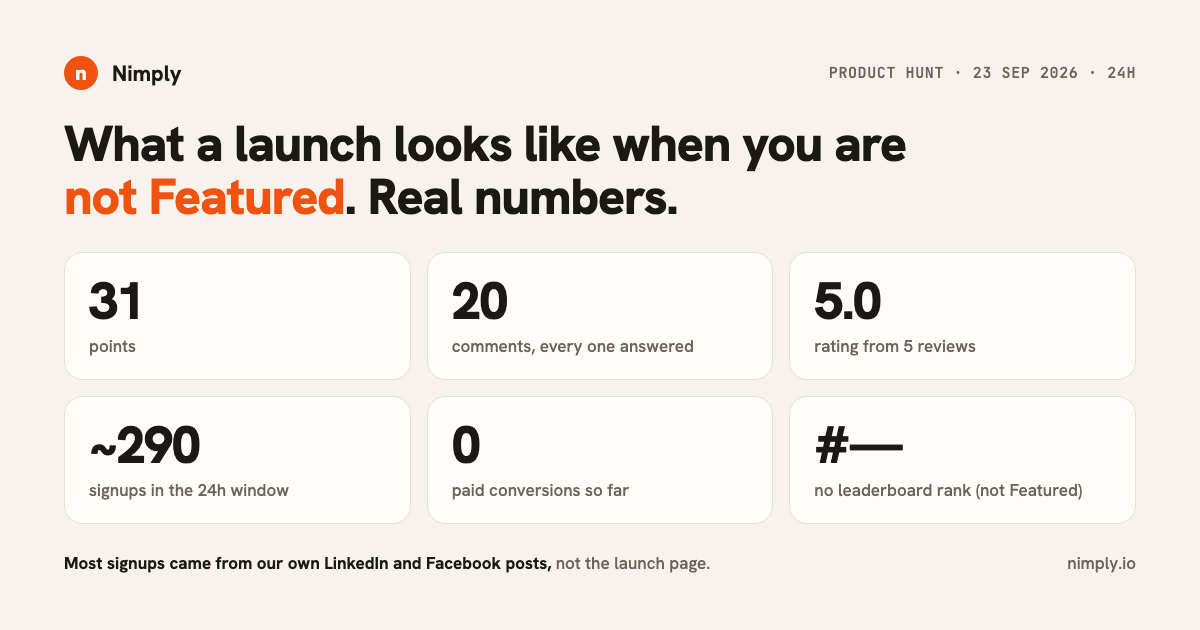
Most Product Hunt launch write-ups are written by the people who won. This one is not. We launched Nimply on Wednesday 23 September 2026, we were not Featured, we finished with 31 points, and we think the numbers are more useful than another "how we got #1" post.
Here is everything that happened over the 24 hours, what worked, what broke, and what we would change.
What we launched
Nimply is an AI social media workforce. You hire agents from a gallery (support replies, lead capture, comment moderation, LinkedIn ghostwriting, carousel design, repurposing, video clipping, trend scouting and more) and they run on top of a full social media platform: a planner publishing to 9 networks, a unified inbox, a visual automations canvas, iOS and Android apps, a browser extension, a public API and an MCP server.
The one rule that shaped the whole launch: agents never publish on their own. They draft, you approve. That line ended up being the thing people actually wanted to talk about.
The numbers
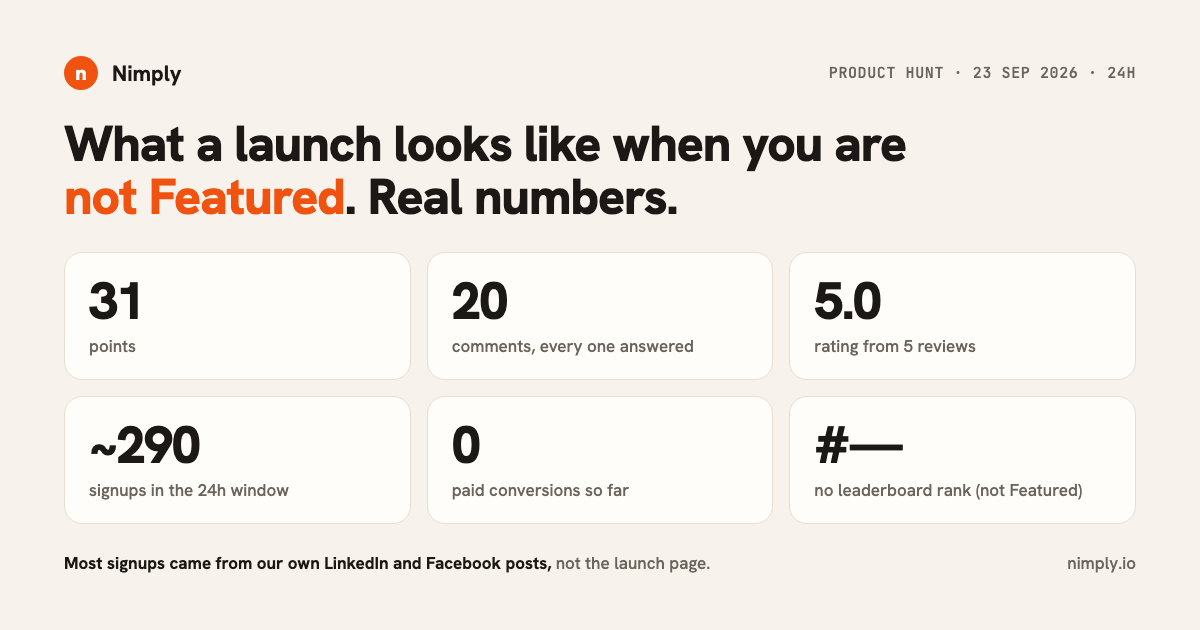
Metric | Result |
|---|---|
Points at close | 31 |
Comments | 20, every one answered |
Reviews | 5, all five stars |
Product Hunt followers gained | 102 |
Leaderboard rank | None. The launch was not Featured. |
Signups on launch day (Wed, UTC) | 175 |
Signups by close the next morning | 115 more, about 290 in total |
New paid subscriptions | 0 |
Two of those rows need explaining.
"Not Featured" means you do not exist on the leaderboard. Product Hunt's editors pick which launches get Featured. Only those launches appear on the daily "Best of" page. Everything else, including ours, is visible to people who already have the link and to nobody else. We knew Featured status mattered. We did not understand until launch morning that without it there is no rank at all, not a low one.
Signups did not come from Product Hunt. The launch page got 31 points. The signup count went up by roughly 290. That gap is our own LinkedIn and Facebook posts, our team's posts, and friends resharing them. The Product Hunt page was the destination we pointed people at, not the source of the traffic.
Hour by hour
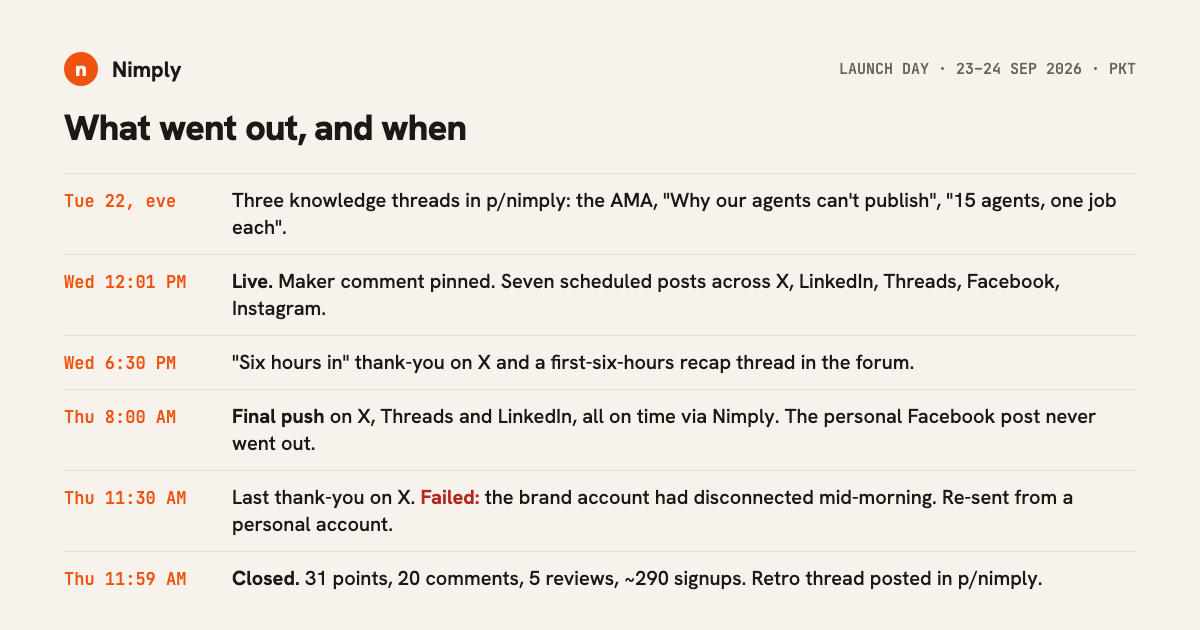
We are in Pakistan, so Product Hunt's day (midnight to midnight Pacific) ran from 12:01 PM on Wednesday to 11:59 AM on Thursday for us. That matters: the "ranking hours", when the US wakes up and the day is decided, are our Thursday morning, after the launch party is over and everyone has gone to bed.
Tuesday evening. Three knowledge threads in our product forum on Product Hunt: a launch AMA, a post on why our agents cannot publish, and a breakdown of what each of the 15 agents does. The idea was to have something worth reading before the launch page existed.
Wednesday 12:01 PM. Live. Maker comment pinned. Seven posts went out from Nimply's own scheduler across X, LinkedIn, Threads, Facebook and Instagram at 12:05 PM. We ate cake in the office. Comments started within the hour.
Wednesday afternoon and evening. Comment replies, a "six hours in" thank-you on X, and a forum thread recapping what people had asked so far. Signups climbed all afternoon as the LinkedIn and Facebook posts spread.
Thursday 8:00 AM. The final push. Posts on X, Threads and LinkedIn all went out on the minute through Nimply. The personal Facebook post we had planned never went out, which we come back to below.
Thursday 11:30 AM. The last thank-you post on X failed. Our brand account's connection had dropped sometime after 8:00 AM. We re-sent it from a personal account.
Thursday 11:59 AM. Closed. We posted the retro thread in the forum within the hour.
The closing morning
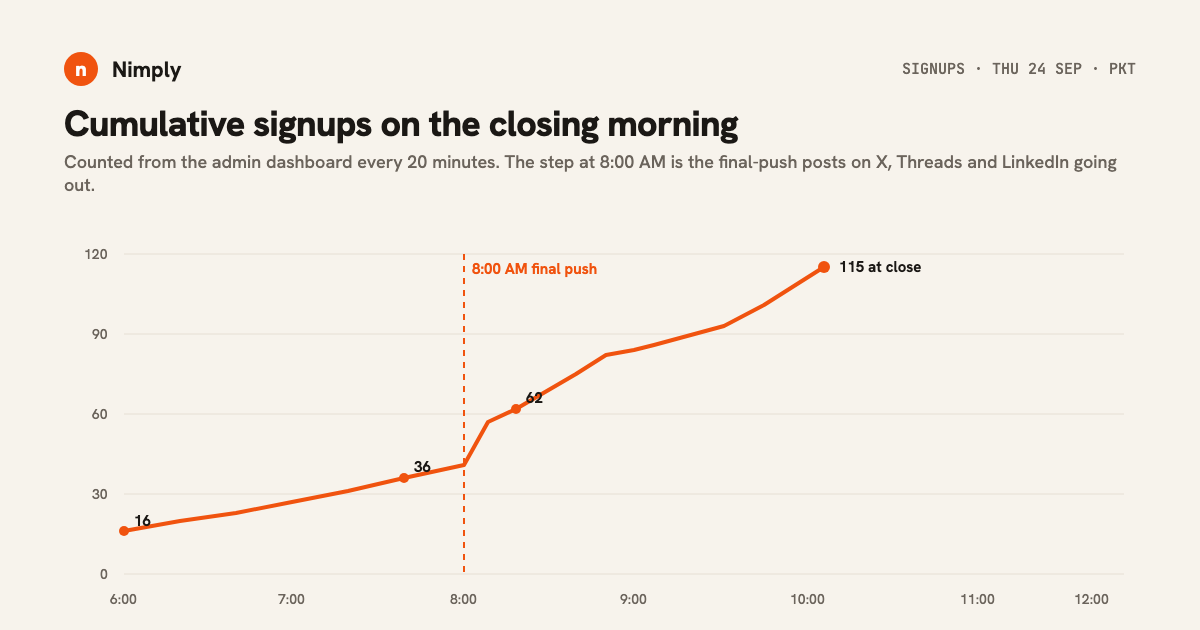
We checked the admin dashboard every 20 minutes through the night and morning. The chart above is that log. The count sat at 16 signups at 6:00 AM, climbed slowly, then stepped from 41 to 57 in the fifteen minutes after the 8:00 AM posts went out. It kept climbing to 115 at close.
Two things stand out. The push worked, measurably, even though it did nothing for the Product Hunt numbers themselves. And the whole morning added zero paid subscriptions. People signed up to look, which is what a free plan is for.
What worked
Answering every comment within minutes. We had a reply on the page before most commenters had closed the tab. This is the single thing we would keep exactly as it was. Nearly every substantive question was about control: will it post without me, can I pause it, what happens when it gets something wrong. Not one was about features. Our answer, that agents draft and you approve, did more work than any screenshot in the gallery.
Publishing everything from our own product. All the launch posts, including the 8:00 AM push, were scheduled inside Nimply days earlier and fired on time. It meant we were not typing posts at 8:00 AM. It also meant that when a channel disconnected, we found out from a failed post rather than from silence.
Writing in the forum the day before. The three pre-launch threads gave commenters something to reference, and gave us something to link to in replies instead of repeating ourselves.
What broke
Our brand X account disconnected mid-morning. The 8:00 AM post went out fine. By 11:30 AM the channel showed as disconnected and the last post failed. We have no idea what revoked it. The lesson is boring and we are writing it down anyway: check every connected account the night before, and again at the start of ranking hours.
The personal Facebook post never went out. Our browser session was signed into the company Page rather than the founder's profile, switching profiles did not take, and we did not want to spend ranking hours fighting a login. The Facebook posts that did go out came from the Page.
A dozen "collab" DMs within hours. From the moment the launch went live, LinkedIn messages arrived offering paid upvotes, paid reviews and mutual-support arrangements. Expect them. They arrive fast, they are persistent, and they are not what a launch is for.
What we would change
We treated launch day as the event. It is not. The event is the two weeks before, spent in the communities where your users already are, so that on the day people already know who you are. We showed up with a good product and a well-run day, and almost nobody on Product Hunt knew us. The 290 signups came from people who did.
We would find out what Featured requires much earlier. Not to game it, but to know before launch day whether the leaderboard is even on the table, and to plan the day around what is.
We would treat the launch page as a lead list, not a leaderboard. 20 thoughtful comments are 20 conversations with people who took the time to think about letting AI near their accounts. That is a better outcome than a badge, and it is the one we are following up on.
Frequently asked questions
How many signups did the Product Hunt launch bring? About 290 new Nimply signups across the 24-hour launch window: 175 on launch day itself and 115 more by the time the day closed the next morning. Most of them came from our own LinkedIn and Facebook posts and from friends resharing, not from the Product Hunt page.
What does it mean when a Product Hunt launch is not Featured? Product Hunt's editors choose which launches are Featured. Only Featured launches appear on the daily leaderboard, so a non-featured launch has no rank at all, no matter how many points it collects. Our launch collected 31 points and never appeared on the leaderboard.
Did the launch produce paying customers? Not on the day. Paid subscriptions stayed flat through the whole launch window. The launch produced signups, comments and conversations, and we are following up with the people who showed real interest.
If you want to see the page this post is about, it is at producthunt.com/products/nimply. If you launched recently without being Featured and saw something different, we would genuinely like to hear it: hello@nimply.io.